
Case studies of our customized automation, built for your business's needs

api integration companies Customized Automation

Missed Calls and Slow Follow-Ups Costing You Sales?

How AI Conversation Bots and Voice Agents in GoHighLevel by Automize Captured and Converted Leads 24/7

This multi-office medical and wellness group handled a constant stream of inbound calls, web inquiries, and appointment requests across several clinics. Demand was strong and consistent, but the volume put pressure on front-desk teams who were already juggling in-person patients, phones, and administrative work.

As a result, missed calls during peak hours became common, and after-hours inquiries often went unanswered entirely. Front-desk staff spent a significant portion of their day responding to the same basic questions, while intake and qualification varied from one location to another. The patient experience depended heavily on who happened to answer the phone.

For many patients, timing was critical. When someone called with an urgent question or appointment need and could not reach a live person right away, they frequently moved on to another provider. Even with GoHighLevel in place, early-stage conversations still relied almost entirely on human availability, creating gaps that directly impacted bookings and continuity of care.

Automize’s plan was to introduce an AI-assisted patient engagement layer inside GoHighLevel that could absorb early-stage conversations without disrupting existing workflows or overloading front-desk teams. Rather than replacing staff, the goal was to ensure that every inbound inquiry was acknowledged immediately and handled consistently, regardless of time of day or call volume.

The strategy focused on using conversational AI for web and SMS intake, paired with an AI voice agent to handle call overflow and after-hours inquiries. Both would be designed to reflect how the organization actually operated, accounting for differences in services and specialties by location, intake and pre-qualification requirements, and appointment availability. Consistency across clinics was a key consideration, particularly around how patients were qualified and routed.

Equally important was visibility and continuity. The plan called for all AI-driven conversations to live inside GoHighLevel pipelines so staff could step in with full context when human involvement was needed. Automated booking links, confirmations, and reminders would support follow-through, while preserving a seamless handoff from AI to staff.

The objective was simple and deliberate: instant response, accurate intake, and a smooth transition to human care, without increasing staff workload or compromising the patient experience.

The AI layer immediately improved patient capture and scheduling across the organization. Every inbound call was answered, even outside normal business hours, and web and SMS inquiries received instant, consistent responses. This ensured that patients were acknowledged right away, regardless of when or how they reached out.

As a result, staff spent far less time handling repetitive intake questions and could focus their attention where it mattered most. Appointment requests were routed accurately by location and service, reducing confusion and ensuring patients were connected to the right clinic without delay.

The impact was felt quickly. More appointments were booked, fewer opportunities slipped through the cracks, and front-desk workload was significantly reduced. Just as importantly, patients experienced a more consistent and reliable experience across every location, regardless of timing or volume.

With AI conversation bots and voice agents fully integrated into GoHighLevel, the medical group captured more demand without adding staff, while simultaneously improving the overall patient experience.

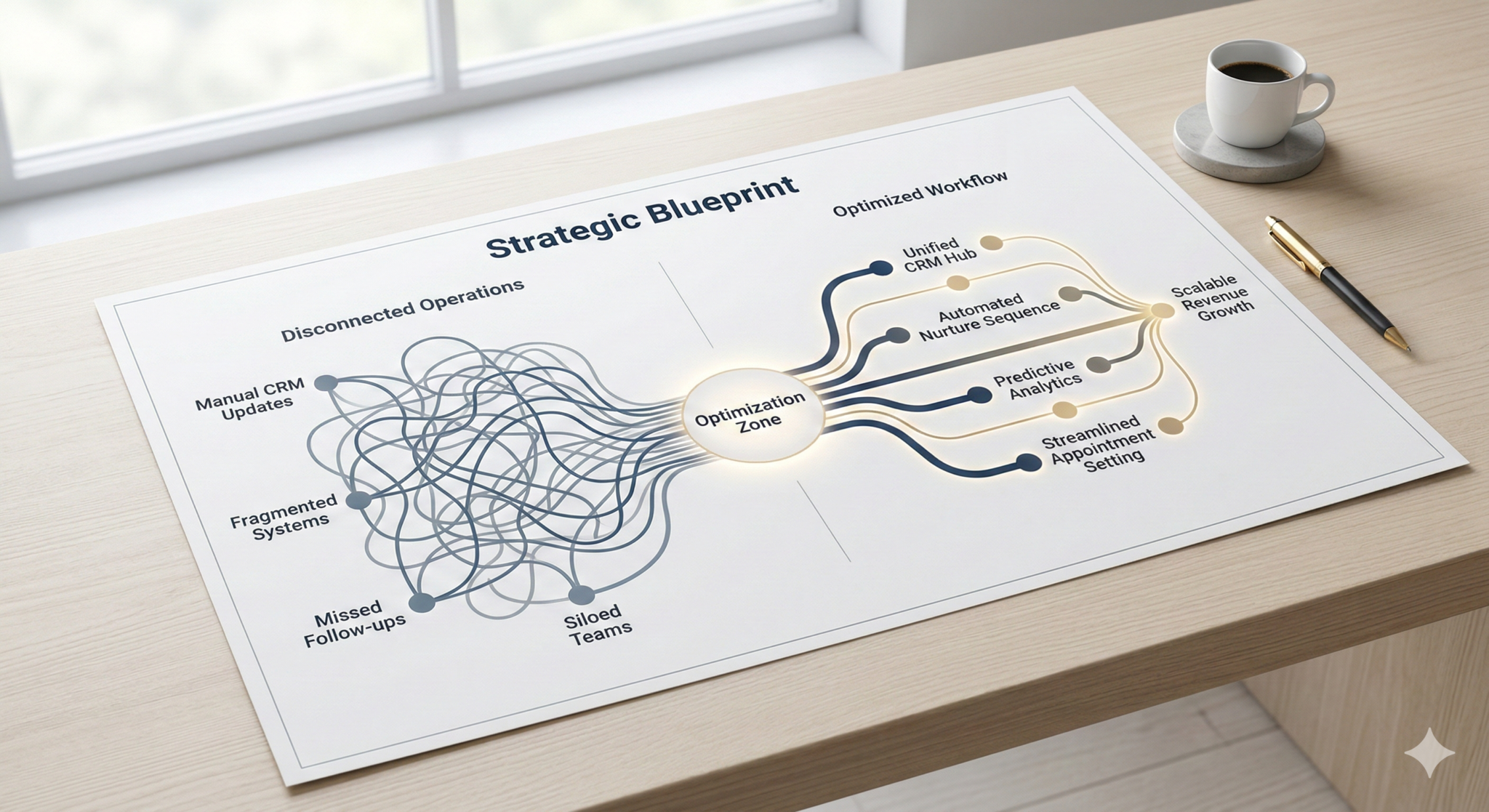
Drowning in Disconnected Systems?

How Customized GoHighLevel Integrations by Automize Eliminated Manual Work and Unified Operations

As a growing home services company serving HVAC, plumbing, and electrical customers across multiple locations, the business relied on a patchwork of software to keep operations running. GoHighLevel handled marketing and CRM, a separate scheduling system managed dispatch and job bookings, payments lived in another platform, and call tracking and reporting existed in yet another tool. Each system performed its individual role well – but none of them truly worked together.

That disconnect quietly created daily friction. Office staff spent hours re-entering customer information from one system into another just to keep records aligned. Appointment changes didn’t always sync in real time, leading to confusion between dispatch, sales, and billing. Payment statuses and job outcomes were often outdated, unless someone manually updated them, and leadership had to rely on spreadsheets and repeated cross-checking to understand what was really happening in the business.

As the company continued to grow, these inefficiencies became harder to ignore. Scaling didn’t just mean more jobs – it meant more administrative work, more opportunities for errors, and more staff added simply to keep systems in sync. Even though each platform worked well on its own, the lack of integration introduced delays, inaccuracies, and unnecessary overhead that slowed the entire operation.

Automize approached the project as a full operational integration, not a series of disconnected, one-off connections. The plan was to step back and understand the business end to end, mapping the entire customer lifecycle from the first inbound call or form submission through job completion and payment. This made it possible to identify where data originated, how it needed to move between systems, and which platform should act as the system of record at each stage.

With that foundation in place, the focus shifted to designing a unified data flow that would keep GoHighLevel aligned with the company’s scheduling, payment, and call-tracking tools. The objective was to ensure that customer information, appointments, job outcomes, and revenue data stayed accurate and up to date everywhere – without relying on manual intervention. Reliability and scalability were core considerations from the start, so the plan also accounted for visibility into failures and safeguards to prevent sync issues from impacting daily operations.

The end goal was clear: a single, cohesive workflow that eliminated manual data handling and allowed the organization to operate from one source of truth.

After implementation, the change was immediate. Customer records stayed consistent across every connected platform, eliminating discrepancies and duplicate entries. Scheduling updates reflected instantly inside GoHighLevel, ensuring dispatch, sales, and billing were always working from the same information. Payments and job completions automatically triggered follow-up messages and review requests, keeping customer communication timely without requiring manual effort.

Behind the scenes, office staff no longer had to copy data from one system to another. Leadership gained access to accurate, real-time reporting across all locations, replacing spreadsheets and guesswork with clear visibility into performance and revenue.

The impact was felt across the organization. Administrative hours were reduced each week, response times improved, and dispatching became smoother and more predictable. Errors and duplicate records dropped significantly, and the business gained a scalable operational foundation that could support future growth without adding unnecessary overhead.

GoHighLevel became the central command center – while every connected platform worked in lockstep through customized automation built by Automize.

No Visibility Into Your Sales Pipeline?

How Customized GoHighLevel Reporting by Automize Gave Leadership Real-Time Revenue Clarity

A fast-growing fitness and training brand was generating steady demand through paid ads, referrals, walk-ins, and online bookings, feeding sales conversations into multiple gyms and coaching teams. On the surface, growth looked healthy – but behind the scenes, that growth introduced complexity the organization struggled to manage.

Each team tracked leads a little differently, and sales conversations were scattered across texts, calls, and side spreadsheets. Trial sessions and membership upgrades were not consistently recorded, making it difficult to understand what was actually converting. Revenue forecasts were often based on assumptions instead of real data, and leadership lacked a clear, real-time view of sales performance across the business.

GoHighLevel was already in place, but without a unified sales structure, it functioned more like a contact repository than a true sales system. The visibility leadership needed simply wasn’t there.

Automize’s plan was to restructure the sales process inside GoHighLevel so it reflected how the business actually converted prospects into members. Rather than forcing teams to adapt to a generic pipeline, the goal was to align sales stages with real customer actions – from initial interest, to trial participation, to membership and upgrades.

The strategy centered on standardization and clarity. Pipeline stages would be defined around meaningful milestones, with movement driven by actual events such as bookings, attendance, and payments. Clear ownership and follow-up expectations would ensure that every lead had a next step, removing ambiguity and reducing drop-off between stages.

Visibility was equally important. The plan called for custom dashboards that translated daily activity into usable insight, giving leadership a clear view of pipeline value, deal aging, conversion rates from lead to trial to member, performance by team and location, and revenue projections grounded in real behavior rather than assumptions.

The focus was simple: turn activity into insight, and insight into better decisions.

Leadership gained immediate clarity into what revenue was truly in play, where leads were stalling, and which teams were converting – and why. For the first time, forecasting growth was based on real pipeline data instead of assumptions, giving decision-makers confidence in both short-term projections and long-term planning.

Sales teams felt the difference just as quickly. Every lead had clear next steps, automated reminders reinforced follow-up accountability, and manual tracking all but disappeared. As a result, fewer opportunities were missed and reps spent more time selling instead of managing spreadsheets.

The impact showed up across the business. Revenue became more predictable, sales operations became cleaner and more consistent, and decisions were made faster with better information. Most importantly, the system scaled alongside the brand, supporting continued growth without adding unnecessary complexity.

With customized GoHighLevel reporting and automation in place, sales visibility finally matched the brand’s growth.

Ready to start automating your small business? Get customized automation set up for your business needs with Automize.

api integration companies Customized Automation

Emails Not Reaching Your Leads?

How Customized Automation by Automize Fixed Deliverability Issues and Reclaimed Revenue at Scale

This life coaching client had built a massive, highly engaged audience, with thousands of people opting in to their content every day. To maintain exceptional inbox placement at that scale, they relied on a specialized email delivery system designed to maximize deliverability and protect sender reputation.

The challenge was built into the system itself. Every new lead needed to be assigned a unique, system-generated email address at the exact moment of opt-in. When that happened, communication flowed smoothly. When it didn’t, everything stopped.

Over time, the client began to notice a growing and troubling pattern. A significant number of new leads were never assigned their specialized email addresses. As a result, those contacts received no emails at all – no follow-ups, no nurture sequences, and no offers. From the outside, it looked as though engaged prospects were simply losing interest.

The impact was immediate and painful. Leads went cold without any clear explanation, engagement metrics dropped, and ROI steadily declined. Traffic and opt-in volume remained strong, yet revenue continued to slip, making it clear that something deeper was breaking inside the automation – even if the source wasn’t immediately obvious.

Automize approached the issue as a systems-level automation audit, not a surface-level fix. Rather than focusing on any single campaign or tool, the plan was to understand how data moved through the entire automation stack and where it could be breaking down.

The strategy centered on mapping every Infusionsoft campaign and trigger where the specialized email address should be assigned, then analyzing historical lead data to identify patterns among contacts that were missing that assignment. From there, attention turned to the broader ecosystem – reviewing all third-party integrations involved in the opt-in process and how they interacted with Infusionsoft.

Because the automation spanned multiple platforms, collaboration was a key part of the plan. The approach included working directly with both the email provider and Infusionsoft’s support and development teams to validate assumptions and eliminate potential failure points.

At its core, the plan treated the problem for what it was – a data-flow issue across a multi-platform automation stack, not a failure of any single tool.

After working closely with the email provider and Infusionsoft’s development support, one critical conclusion became clear – there was nothing wrong with the email assignment process itself.

The real issue originated elsewhere. Further investigation revealed that the client’s webinar platform was passing data into Infusionsoft inconsistently and in large bursts. During these sync events, Infusionsoft was effectively locked, preventing other platforms from passing data at the same time. As a result, the specialized email system was blocked from assigning email addresses to new leads when timing overlapped.

Once the failure point in the data-passing sequence was identified, we provided the client with clear technical guidance to relay back to the webinar provider. The integration timing was restructured so data flowed into Infusionsoft cleanly and consistently, without interfering with other systems.

With that correction in place, every new lead was automatically assigned their specialized email address, exactly as intended.

The outcome was immediate. Email deliverability was fully restored, nurture sequences resumed without interruption, engagement levels returned to normal, and ROI recovered to expected levels. What initially appeared to be a deliverability issue turned out to be a data-flow conflict buried inside a multi-platform automation stack.

This case underscores the real value of deep automation expertise – sometimes the problem isn’t the tool, it’s how the tools communicate with each other.

Automation Campaigns Not Resulting in Sales?

How Customized Automation by Automize Recovered Tens of Thousands in Lost Revenue

As a premier showroom in their market, this client consistently attracted high-quality traffic, both in person and online. Prospective customers regularly opted in, often explicitly stating interest in specific products, making the sales opportunity clear from the start.

A few months after launching their new Infusionsoft application, however, a troubling pattern began to emerge. Leads who had shown clear buying intent suddenly stopped engaging with emails. Follow-up sequences showed sharp drop-offs, and very few of these prospects ever converted into sales. On the surface, it appeared as though interest was fading for no obvious reason.

Because the opt-in campaigns and automation had been built by an enterprise-level Infusionsoft agency, the initial assumption was that everything was functioning as designed. But interest without follow-up quickly became a costly problem. Revenue was quietly slipping through the cracks, even though traffic and lead quality remained strong.

Automize approached the issue by auditing the automation from the lead’s perspective. The plan was to understand exactly what a prospect experienced after opting in, rather than relying on assumptions about how the system was supposed to work.

That meant reviewing every opt-in path on the client’s website and mapping the customized automation tied to interest-based forms. We then traced individual lead journeys through Infusionsoft campaigns and examined email engagement history to identify the precise point where engagement stopped.

The objective was simple but critical – determine whether leads were intentionally opting out, or whether something in the automation itself was preventing emails from being delivered at all.

The issue became clear during discovery, and it was critical. A flaw in the agency-built campaign logic caused every lead who filled out an opt-in form to fall out of the campaign less than an hour after entering it. From that point forward, the automation simply stopped.

As a result, no interest-specific follow-up emails were ever delivered. Leads never received product education or sales prompts, and high-intent prospects quietly went silent, even though they had explicitly raised their hand moments earlier.

During the audit, we identified more than 400 leads that had been unintentionally dropped from the campaign, each with an estimated value of $1,000 or more. Automize corrected the faulty automation logic and reintroduced those leads back into the appropriate campaigns, allowing the gallery’s sales team to re-engage prospects with timely, relevant follow-up.

The impact was immediate and measurable. Hundreds of stalled leads were reactivated, sales reps were able to resume proper outreach, and tens of thousands of dollars in potentially lost revenue were recovered.

This case underscores a critical truth – automation that looks sophisticated can still fail if it isn’t engineered correctly. When customized automation works the way it should, sales follow naturally.

Struggling to Keep Client Conversations in One Place?

How Automize Unified Sales & Marketing Communication Through Customized Automation

As a busy real estate office, this client wanted to expand how their agents communicated with prospects while keeping every interaction logged in one place – their Infusionsoft application. The goal was simple in theory: streamline communication without sacrificing visibility or accountability.

A previous Infusionsoft developer had built a communication form that was supposed to handle the basics – sending emails and booking appointments. In practice, even those core functions were unreliable. Messages didn’t always send, appointments didn’t always book correctly, and the customized automation clearly needed a serious upgrade.

Beyond fixing what was broken, the client had bigger ambitions. They wanted agents to send emails, texts, and appointment invites from a single form, register prospects for the client’s app and website directly from that same interaction, track how often prospects responded to outreach, and log all inbound and outbound communication – including email, SMS, and calls – inside Infusionsoft.

What they needed wasn’t another patch or workaround. They needed one communication system that worked reliably, scaled with their team, and gave leadership clear visibility across the entire office.

Automize approached the project as a full communication-system rebuild, starting with stability and then expanding functionality in a deliberate, structured way. The plan was to first ensure that the foundation worked reliably before layering on new communication channels and visibility.

The initial focus was on stabilizing what already existed. That meant confirming whether emails were being properly triggered on form submission and correcting gaps or broken logic within the existing Infusionsoft campaigns. Appointment booking was addressed next, with a review of the current scheduling integration to identify where workflows were failing and how booking reliability could be improved.

Once the core communication paths were stable, the plan expanded to support additional channels. The form would become a true communication hub, allowing agents to send SMS messages, register prospects for the client’s app and website, and capture responses across email, text, and phone calls. A key consideration throughout was ensuring that inbound communication could be tracked consistently, regardless of how a prospect chose to respond.

Finally, the plan called for clear visibility and accountability. Easy-to-read dashboards would give both managers and agents instant insight into response rates and engagement, making it simple to see what was working, where follow-up was happening, and where opportunities were being missed.

The upgraded communication system completely transformed how the team worked. Agents could immediately see when a prospect replied to an email and follow up via text without delay. Interested clients could be registered for the app and website in seconds, and property-viewing appointments could be booked directly from the same form – without switching tools or re-entering information.

Every interaction was captured in one place. Email, SMS, and phone activity flowed into a centralized dashboard, giving agents and managers a complete view of each client conversation. All of this happened from a single Infusionsoft form, eliminating the need to jump between systems or piece together communication history.

The impact was clear. Follow-ups became faster, agent accountability improved, and leadership gained visibility into how responsive prospects were across the entire team. Just as importantly, the office ended up with a scalable communication system that actually supported sales, rather than slowing them down.

This is the power of properly executed customized automation – one form, one system, and complete control over the client conversation.

Ready to Improve Your Automation?