For years, the “holy grail” of business automation was the ability to respond to a lead the second they reached out. We mastered the auto-reply text and the instant email. But as we move through 2026, the consumer landscape has shifted again. While text is convenient, high-value leads—especially in the home services, medical, and legal sectors—still want to talk to a human. Or, at the very least, they want a voice on the other end of the line that can actually solve their problem.
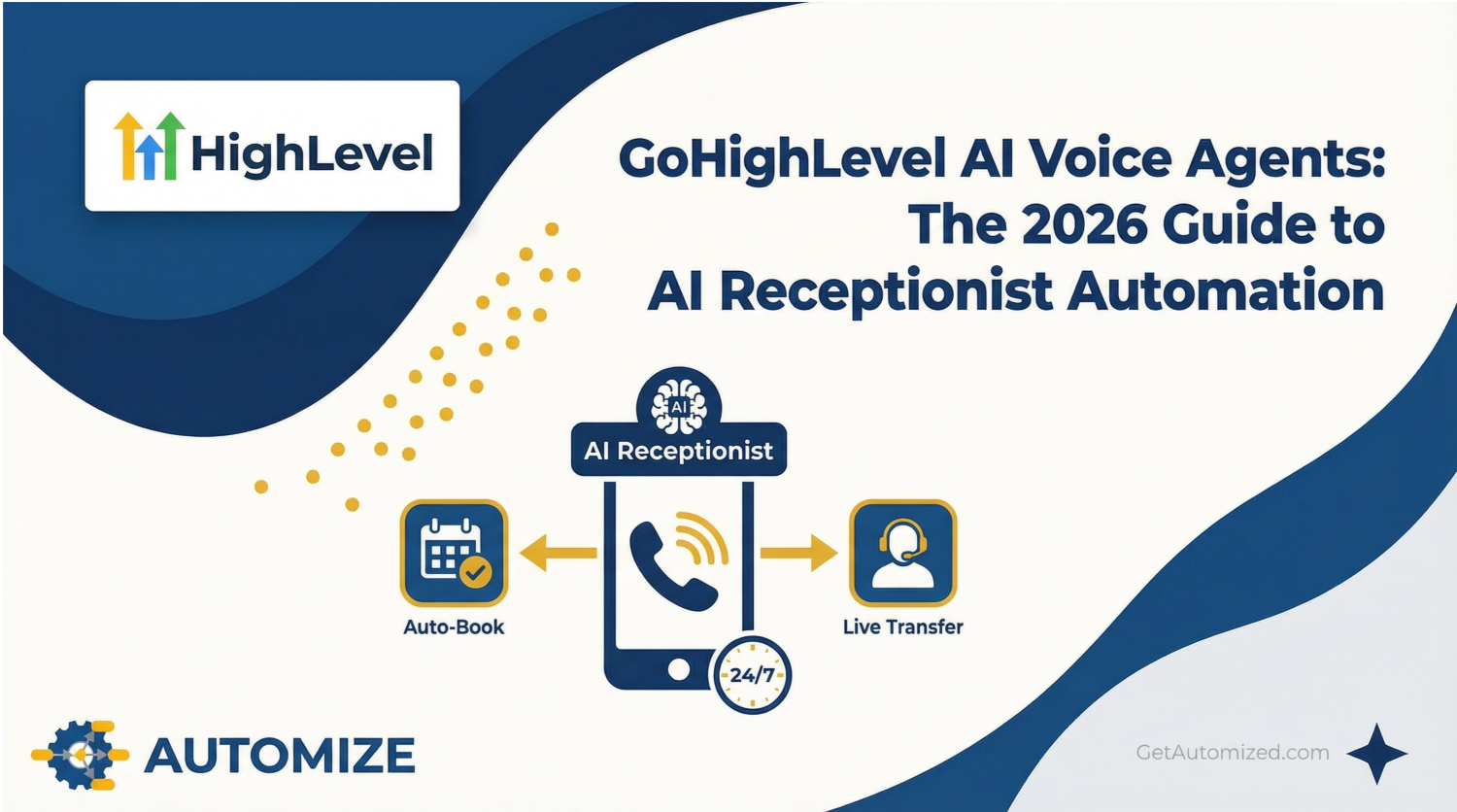
The era of “Press 1 for Sales” is dead. In its place, the GoHighLevel Voice AI Agent has emerged as the most disruptive technology for small businesses and agencies alike. We are no longer limited to the now-outdated missed call text back workflow; we are now in the age of automated AI phone calls that sound, act, and think like a seasoned AI receptionist.
If you are looking to scale your business without doubling your front-desk staff, understanding how to implement GoHighLevel AI Voice is the most important move you can make this year.
What is a GoHighLevel Voice Agent?
A GoHighLevel Voice AI Agent is a sophisticated conversational system that can handle full, natural-language phone calls. Unlike the robotic IVR systems of the past, these agents use advanced Large Language Models (LLMs) and high-fidelity text-to-speech technology to engage in real-time dialogue.
In our experience working with dozens of agencies, the key differentiator in 2026 is latency. The “pause” between a human speaking and the AI responding has dropped to sub-500 milliseconds. This means the conversation flows naturally. The AI doesn’t just read a script; it listens, understands the caller’s intent, and provides relevant answers based on your specific business data stored in the GoHighLevel CRM.
Whether it’s an inbound call from a prospect asking about pricing or an outbound call to follow up on a new lead, these agents operate with 100% consistency, 24 hours a day, 7 days a week.
The Great Debate: Vapi vs. Native GHL Voice
As you begin your journey into voice automation, you will quickly encounter a technical fork in the road: Vapi vs. native GoHighLevel Voice AI. Both are powerful, but they serve different needs within the GoHighLevel ecosystem.
Native GoHighLevel Voice AI
The native voice features within HighLevel are designed for ease of use and deep integration. Because the tool is built directly into the platform, it has immediate access to your CRM data, calendars, and workflows without needing complex API “bridges.” For most businesses looking for a reliable AI receptionist to handle bookings and basic FAQs, the native solution is the most streamlined path to success.
Vapi and Third-Party Integrations
Vapi, and similar tools like Air AI, are specialized voice platforms that “plug into” HighLevel via webhooks. These are often the choice for “Power Users” who require extreme customization of the voice’s personality, ultra-low latency, or complex multi-step logic that goes beyond standard booking. However, these systems require a much higher level of technical expertise to maintain.
Regardless of which path you choose, the goal remains the same: ensuring no phone call ever goes to voicemail again.
Key Benefits of AI Phone Automation for Your Business
Implementing AI phone automation isn’t just about looking “tech-forward”—it’s about the bottom line. Here is why businesses are racing to adopt this technology in 2026:
•100% Answer Rate: Every missed call is a missed opportunity. An AI agent ensures that whether a lead calls at 2:00 PM or 2:00 AM, they are greeted by a professional representative of your brand.
•Immediate Qualification: Your AI agent can “gatekeep” your calendar. It can ask the qualifying questions you need (e.g., “Are you the homeowner?” or “Is your budget over $5,000?”) before it ever allows an appointment to be booked.
•Infinite Scalability: A human receptionist can handle one call at a time. A GoHighLevel Voice AI Agent can handle 100 calls simultaneously. You can scale your marketing spend without worrying if your team can handle the influx of calls.
•Cost Efficiency: The cost of an AI agent is a fraction of a human salary. You eliminate the overhead of recruitment, training, benefits, and office space.
Solving the Outbound Puzzle with the GHL AI Voice Dialer
While inbound reception is the most common use case, the GHL AI Voice Dialer is the secret weapon for sales-heavy organizations. Imagine a system that automatically calls every lead that fills out a form on your website within 30 seconds.
If the lead answers, the AI engages them in a qualifying conversation and, if they are a fit, live-transfers the call to one of your human closers. This “Speed to Lead” is the single biggest factor in closing deals in 2026. By using automated AI phone calls for the initial “cold” outreach or “warm” follow-up, your sales team stays focused only on speaking with people who are ready to buy.
Setting Up Your AI Voice Workflow for Success
The difference between a failed Voice AI project and a successful one comes down to one thing: treating it like an employee. You wouldn’t throw a human onto the phones without a manual, and you shouldn’t do that with AI either. The framework we use involves:
•The Knowledge Base: Inside the GoHighLevel Agent Studio, you must feed the AI your “Source of Truth.” This includes your service list, pricing, common objections, and “The Vibe” of your brand.
•The Workflow Integration: Using the GoHighLevel automation builder, you need to tell the system what to do after the call ends. If the call was successful, move the lead to “Booked.” If they hung up, trigger a “Sorry we got disconnected” text.
•The Human Safety Net: Always have a “fail-safe.” If the AI gets a question it can’t answer, it should be programmed to say, “That’s a great question that requires a specialist’s touch. Let me get a manager to call you back immediately,” and then trigger an internal notification to your team.
Your Phone Is Ringing. Who’s Answering?
In 2026, the gap between market leaders and everyone else will be defined by who answers the phone. While your competitors are sending leads to voicemail, you could be booking qualified appointments on autopilot. Implementing a Voice AI strategy isn’t just about adding a feature; it’s an investment in operational leverage and infinite scalability.
At GetAutomized, we don’t just set up bots. We architect revenue systems. We build the custom logic, the fail-safe workflows, and the reporting dashboards that turn Voice AI from a novelty into your most profitable employee.
Frequently Asked Questions
How “human” do GoHighLevel AI Voice Agents actually sound in 2026?
The 2026 generation of GoHighLevel Voice Agents has moved past the robotic “text-to-speech” era. They now utilize advanced emotional prosody, allowing the AI to whisper, laugh, or adjust its tone based on the caller’s mood. With latencies now under 600ms, the conversation feels real-time. Most callers cannot distinguish the GoHighLevel AI Voice Agent from a human receptionist, especially when using high-fidelity voice “clones” or the premium ElevenLabs integration.
What are the legal requirements for using AI for outbound calls?
Outbound AI calling is strictly regulated in 2026. To use a GoHighLevel Voice Agent for outbound outreach, you must pass a mandatory KYC (Know Your Customer) check within the GHL dashboard. Additionally, the system enforces “Call Hour Safeguards” (typically 10 AM–6 PM), restricts calls to contacts who have explicitly opted-in via a GHL form, and limits each contact to a maximum of 4 calls in a 14-day window to ensure compliance with FCC and TCPA guidelines.
Can the Voice AI agent transfer a call to a live human?
Yes. One of the most critical GoHighLevel AI Workflow examples involves “Live Escalation.” You can program your agent to detect specific keywords (e.g., “I want to speak to a manager”) or high-stress levels in a caller’s voice. When triggered, the AI agent can instantly transfer the call to your office line or a specific team member’s cell phone, providing a seamless handoff from AI to human.
Does the Voice Agent work with HIPAA-compliant accounts?
Yes, but it requires the GHL HIPAA-compliant upgrade ($297/mo). Once enabled, all voice transcripts, call recordings, and patient data captured by the GoHighLevel AI Voice Agent are encrypted with AES-256. This allows medical and dental practices to use AI for patient intake and appointment reminders while remaining fully compliant with healthcare privacy laws.
What is the cost difference between Inbound and Outbound AI calls?
While the Unlimited AI Employee plan ($97/mo per sub-account) covers the “intelligence” of the bot, there are still telephony usage fees. In 2026, the standard rates are approximately $0.014/minute for outbound calls and $0.0085/minute for inbound calls. Because these are usage-based, SaaS owners can use the SaaS Configurator to rebill these costs to their clients with a small markup, turning their voice automation into a profit center.